Bulletin Search
Disciplinary Actions
ADVANTAGE PROPERTY MANAGEMENT LLC (THOMASVILLE) – By Consent, the Commission suspended the firm license of Advantage Property Management LLC for a period of 24 months, effective July 30, 2025. The Commission then stayed the suspension in its entirety upon certain conditions. The Commission found that Commission staff audited the Firm’s trust accounting records for the period of June-December 2023 and discovered multiple violations of Commission trust accounting rules, including failure to account for trust monies within a reasonable time, commingling, failure to deposit trust funds into the trust account within three banking days, and failure to properly maintain trust account records. The Firm also did not make all records available for inspection as requested by Commission staff.
JACQUELINE HUTTOE – The Commission accepted the permanent voluntary surrender of the real estate license of Huttoe, effective July 16, 2025. The Commission dismissed without prejudice allegations that Huttoe violated provisions of the Real Estate License Law and Commission Rules. Huttoe neither admitted nor denied misconduct.
PHILIP D LEINWAND (WILMINGTON) – By Consent, the Commission suspended the broker license of Leinwand for a period of one-month, effective August 1, 2025. The Commission found that in 2005, Leinwand completed and filed an Application for a Real Estate Salesperson License with the Commission and provided false information in the application. In 2006, Leinwand completed and filed an Application for a Real Estate License with the Commission and provided false information in the application. In 2021, Leinwand completed and filed an Application for a Real Estate Firm License with the Commission and provided false information in the application. Leinwand failed to make full disclosure of all required information in his applications to the Commission in 2005, 2006, and 2021.
JENNIFER M MCCLUSKEY (THOMASVILLE) – By Consent, the Commission suspended the broker license of McCluskey for a period of 24 months, effective July 30, 2025. The Commission then stayed the suspension in its entirety upon certain conditions. The Commission found that in July 2023, after being designated as the Broker-in-Charge (BIC) for Advantage Property Management LLC, McCluskey designated herself as the Qualifying Broker and falsely certified to the Commission that she was an officer/manager/general partner of the firm, when she was not. An audit conducted by Commission staff while McCluskey was BIC for the firm evidenced multiple violations of Commission trust accounting rules, including failure to account for trust monies within a reasonable time, commingling, failure to deposit trust funds into the trust account within three banking days, and failure to properly maintain trust account records. McCluskey also did not make all records available for inspection by Commission staff as requested and did not properly supervise unlicensed staff members.
ROGER A PARHAM (CHARLOTTE) – The Commission accepted the permanent voluntary surrender of the real estate license of Parham, effective July 16, 2025. The Commission dismissed without prejudice allegations that Parham violated provisions of the Real Estate License Law and Commission Rules. Parham neither admitted nor denied misconduct.
PAUL E PORTERFIELD (GRIFTON) – By Consent, the Commission suspended the broker license of Porterfield for a period of 9 months, effective July 30, 2025, after he failed to comply with certain conditions of his Consent Order. The Commission found that Porterfield failed to use written agreements for broker services, allowed his unlicensed firm to be paid a commission for real estate brokerage services, and failed to deposit trust monies in a trust account within three banking days of receipt.
WILLIAM W RIKE (NEWPORT) – By Consent, the Commission suspended the broker license of Rike for a period of 6 months, effective July 1, 2025. The Commission then stayed the suspension in its entirety upon certain conditions. The Commission found that Rike received a lead from the assumed seller of a vacant lot. Rike executed a listing agreement with the assumed seller and failed to take reasonable steps to identify this individual. Rike believed the email address belonging to the assumed seller was legitimate because it matched the name of the true owner. Rike had the assumed seller sign the listing agreement electronically. The vacant lot went under contract with a potential buyer; however, the contract was terminated. The transaction successfully closed with a second buyer, but after it was discovered that the assumed seller was fraudulent. The true owner was unaware of the transaction until after the transaction closed.
KENNETH U ROUNDTREE (GREENSBORO) – The Commission accepted the permanent voluntary surrender of the real estate license of Roundtree, effective July 16, 2025. The Commission dismissed without prejudice allegations that Roundtree violated provisions of the Real Estate License Law and Commission Rules. Roundtree neither admitted nor denied misconduct.
ROBERT E SCHNEIDER (LONGS, SC) – The Commission accepted the voluntary surrender of the real estate license of Schneider, effective July 16, 2025, with no right to reapply for three years. The Commission dismissed without prejudice allegations that Schneider violated provisions of the Real Estate License Law and Commission Rules. Schneider neither admitted nor denied misconduct.
STEEL SKIN REALTY LLC (CHARLOTTE) – The Commission accepted the voluntary surrender of the real estate firm license of Steel Skin Realty LLC, effective July 16, 2025. The Commission dismissed without prejudice allegations that the Firm violated provisions of the Real Estate License Law and Commission Rules. The Firm neither admitted nor denied misconduct.
Commission Presentations
July 2025 Presentations
Dillian Hecht, Associate Legal Counsel II, spoke at Brunswick County Association of REALTORS® on July 11th.
Lyndi James, Auditor, spoke at Realty One Group Affinity on July 16th.
Brian Heath, Consumer Protection Officer, spoke at Carolina Smokies Association of REALTORS® on July 17th.
August 2025 Presentations
*These presentations are subject to change due to the availability of Commission members and/or staff.*
Jean Hobbs, Auditor/Investigator, will speak at Keller Williams Realty Fayetteville on August 5th.
Bruce Rinne, Information Officer, will speak at Lincoln County Board of REALTORS® on August 5th.
Miriam Baer, Executive Director, will speak at Neuse River Region Association of REALTORS® on August 20th.
Bruce Rinne, Information Officer, will speak at Lantern Realty and Development LLC on August 27th.
Reminder: Ensure Your CE Courses Are Posted Accurately
Recently, some brokers discovered that their CE courses completed during the 2024-2025 license year weren’t posted to their license record because of an error by their education provider. This lead to their licenses being placed on inactive status. According to Rule 58H .0207(f), Education Providers (EPs) are required to submit course completion reports to the Commission within 7 calendar days of a brokers completion of the course.
Mistakes can happen. To prevent surprises at renewal, brokers should:
- verify their course completion certificate for accuracy, especially as to name and license number,
- log into www.ncrec.gov to confirm all CE courses are listed within 10 days of completion, and
- request an EP to correct any errors and/or timely submit their course completion information to the Commission if they have not done so in adherence to License Law and Commission rules.
Brokers should not send their course completion certificates to the Commission. EPs are required under Rule 58H .0207(f) to submit this information within 7 calendar days of a broker’s completion. The Commission asks brokers to regularly review their license record to ensure their license status remains active and to prevent any disruption in brokerage activities.
Fair Housing Training
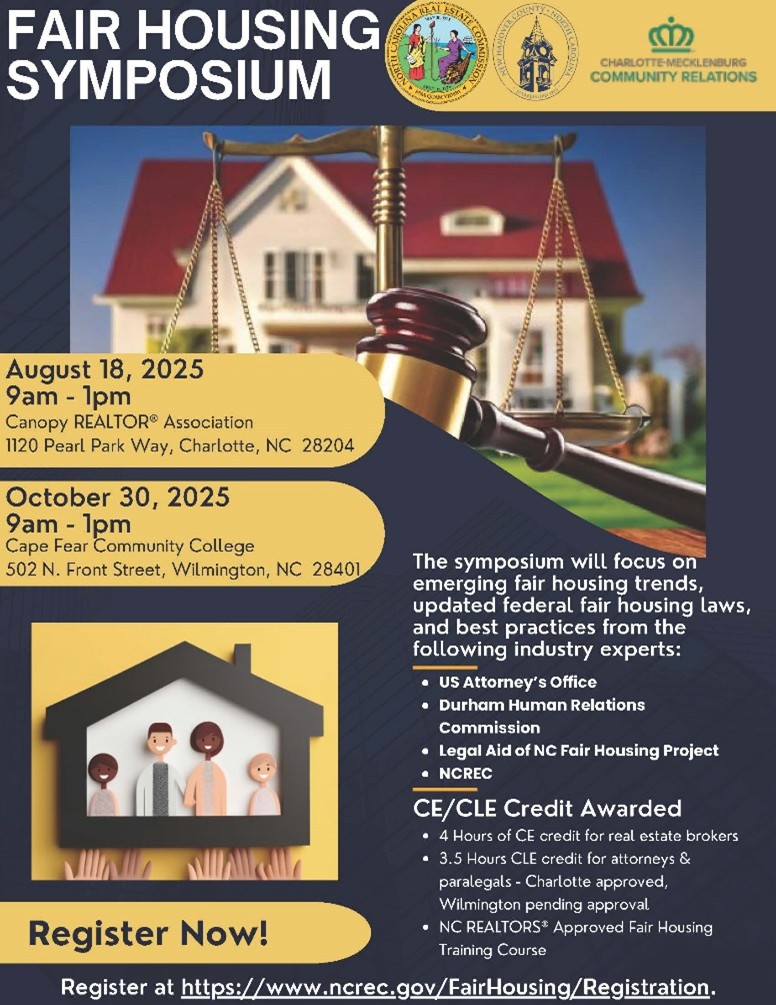
In April of this year, the North Carolina Real Estate Commission hosted the first of three Fair Housing Symposia. This series of continuing education training is hosted in collaboration with presenters from the state and local Human Relations Commission, Legal Aid of North Carolina Fair Housing Project, and the United States Attorneys’ Office. During these training courses, attendees gain valuable knowledge and insight into the various components of fair housing laws, including some lesser-known areas of enforcement, hearing directly from experts who investigate and prosecute fair housing violations.
The second symposium will be held in Charlotte on August 18th. The third and final offering will be held in Wilmington on October 30. Don’t miss out on the opportunity to gain a greater understanding of your duties under fair housing laws, emerging fair housing trends, and pick up some best practices as a practitioner. Real estate brokers will earn 4 hours of CE credit and satisfy the National Association of REALTORS® fair housing training requirement. Attorneys and paralegals will earn 3.5 hours of CLE credit. Limited seats remain, so be sure to register here today.
William “Bill” Aceto Elected Chair, Melvin “Skip” Alston, Vice Chair
Executive Director Miriam Baer announced that William “Bill” Aceto of Boone has been elected as Chair and Melvin “Skip” Alston of Greensboro as Vice Chair of the North Carolina Real Estate Commission. Their terms will begin on August 1, 2025.
Bill Aceto was appointed to the Commission by the General Assembly in 2023. Licensed since 2007, Aceto specializes in investment properties, commercial real estate, development, large acreage tracts, building lots, residential brokerage and long-term property management. As a REALTOR® committed to property owners’ rights, Aceto also personally invests in rental properties, land tracts, and residential properties in the High Country. Aceto and his Blue Ridge Realty & Investments partner, Todd Rice, also co-founded and operate Blue Ridge Professional Property Services, LLC, Boone High Country Rentals, and Ashe Rental Agency.
Having held leadership positions for the High Country Association of REALTORS®, including President in 2019, Aceto was named the 2020 High Country Association REALTOR® of the Year. Aceto is active in the North Carolina REALTORS® and was a 2015 Graduate of the NC REALTORS® Leadership Academy. He has been the Chair of NCR Legislative and RPAC Committees as well as its Property Management Division (PMD), and was also a Federal Political Coordinator for NAR® for over 10 years. Additionally, he has served as a public member on the North Carolina Building Commission, is a former member of the Town of Boone Board of Adjustment (ETJ Alternate), and past Chairman of the Watauga County Board of Elections. He graduated from Appalachian State University with a degree in Political Science with minors in Business and Criminal Justice and served as the Chair of Appalachian State Board of Visitors.
Bill lives in Boone with his wife, Sallie and children, Liam (8) and Maggie ( 6 ).
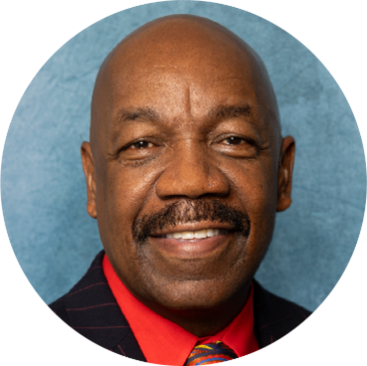
Melvin “Skip” Alston was recently appointed to the Commission by Governor Roy Cooper on October 9, 2024. Mr. Alston is the owner and founder of The Alston Realty Group, Inc. in Greensboro, NC, which has been in continuous operation serving the greater Greensboro area for over 42 years. A recipient of the Order of the Long Leaf Pine, Mr. Alston has served as a leader in his community, across North Carolina and the nation since 1987. He has served in numerous capacities and on several Boards. He is the current chairman for the Guilford County Board of Commissioners and has served on the board for 27 years. He is also a Diamond-Life Member of the NAACP and has served on their local, state and national levels for over 25 years. Mr. Alston has also served as the North Carolina NAACP President.
He is the Co-Founder and Co-Chairman of the Board of Directors for Sit In Movement, Inc. a nonprofit corporation formed for the purpose of purchasing and renovating the Historical Woolworth Building in downtown Greensboro into an International Civil Rights Center and Museum, which opened February 1, 2010.
Mr. Alston previously served on the North Carolina Real Estate Commission, appointed in 2003 by the Speaker of the House and elected Chairman of the Commission in 2007 and again in 2008.
A Durham native, Mr. Alston attended North Carolina Central University, with a major in Business Administration. He has been licensed as a broker since 1982. Mr. Alston, his wife Gwendolyn and their adult sons, DeSean and Ryan, are based in Greensboro and are all North Carolina real estate brokers.
A Message from Regulatory Affairs About Commission Rule A. 0112:
The Commission is complying with Session Law 2025-52 (Senate Bill 690) by initiating permanent rulemaking to amend 21 NCAC 58A .0112: Offers and Sales Contracts. During this rulemaking process, the Commission will not enforce the provisions of the current rule that are subject to change. A broker acting as an agent in a real estate transaction may use a preprinted offer or sales contract form containing provisions concerning the payment of a commission or compensation, including the forfeiture of earnest money, to a broker or firm.
This action is taken in accordance with legislative direction and is designed to provide clarity during the rule revision period.
The public hearing scheduled for August 14, 2025, at 9am, will only address proposed changes to 21 NCAC 58A .0503. The Commission will hold a public hearing on changes to 21 NCAC 58A .0112 as directed by the legislature at a later date. Subscribe to the Commission’s mailing list to receive notice of rulemaking: Subscribe to our mailing list
For questions or additional information, please contact Regulatory Affairs at (919) 719-9180.
Commission Presentations
June 2025 Presentations
Lyndi James, Auditor, spoke at Coldwell Banker Sea Coast Advantage June 10th.
Mel Black, Commission Member, accompanied by Janet Thoren, Director of Regulatory Affairs, spoke at Cleveland County Association of REALTORS® on June 11th.
Dillian Hecht, Associate Legal Counsel II, spoke at Allen Tate Glenwood on June 24th.
July 2025 Presentations
*These presentations are subject to change due to the availability of Commission members and/or staff.*
Dillian Hecht, Associate Legal Counsel II, will speak at Brunswick County Association of REALTORS® on July 11th.
Lyndi James, Auditor, will speak at Realty One Group Affinity on July 16th.
Brian Heath, Consumer Protection Officer, will speak at Carolina Smokies Association of REALTORS® on July 17th.
Quick Tips

It’s a new license year, do you know the status of your license? Go to the Broker Login to ensure you have a current and active license.
A. Cox, Education Officer
Did you miss the renewal deadline? Visit our reinstatement page.
T. Ross, Education Officer
Attention BICs: please encourage all your brokers to subscribe to the monthly eBulletin.
B. McGonigle, Education Officer
To ensure that you do not miss important deadlines, please place an annual recurring reminder on your mobile device to complete your CE by June 10th and renew your broker and/or firm license by June 30th each year.
A. Conyers, Logistics and Program Manager
Are you a part of the NCREC licensee Facebook group? Request to join today to get important licensee information.
D. Jasany, Communications Officer
Tech Corner: Ordering the NC Real Estate Manual

Script: This video is a how-to on purchasing the North Carolina Real Estate Manual.
The North Carolina Real Estate Manual is required for post-licensing education courses. You can purchase a digital version for a one-time $25.00 fee for a two-year subscription, or you can purchase a hard copy to be mailed to you for $40.00 plus shipping.
To purchase the digital version of the manual, visit ncrec.gov. Click on the publications tab and click on publications in the drop-down menu. Once you are on the publication page, scroll down to the NC Real Estate Manual Tab. Click on it and click on ‘Register for Digital Subscription’.
Once you are on the registration page, fill out the required fields. You are registering for a digital manual account on this page; this account is not associated with your licensee login. Once you register for an account, you will be prompted to purchase the digital manual for $25.00. Once you have paid for the manual, you will have access.
To access the manual, visit ncrec.gov, click on the publications tab, and then click on publications in the drop-down. Once you are on the publications page, click on NC Real Estate Manual. Click on Access Digital subscription. This will take you to the manual page, click on sign in, in the upper right-hand corner of the page, and enter your login information that you created on the registration page.
NOTE: This is an ONLINE ONLY based product and therefore is not printable or downloadable. Features of the digital publication include: self-check assessments, informative graphics, keyword searches, quick access to Postlicensing course content, and a database of sample contract forms.
To purchase the hard copy of the manual visit ncrec.gov, click on the publication tab, click on publication in the drop down menu. On the publications page click on NC Real Estate Manual, go to Latest Printed Version and click on order here.
Add the manual to your cart then click on cart in the top right hand corner, click on view the full cart.
Click on proceed to check out. Enter the information if you are a new customer. (this means you have not purchased anything previously from our publications website, this login information is not related to your licensee login). Once you login to your publications account or create a new login you can proceed with purchasing the manual.
NOTE: You cannot pick up a manual from the Commission building.
The most up to date version of the North Carolina Real Estate Manual is the 2023 purple cover.
For more information visit the Commission’s website.