Bulletin Search
Commission Resources
Did you know the Commission’s website (ncrec.gov) offers a wide variety of resources for brokers and consumers?
Resources for brokers include:
- Licensee Login that enables brokers to review their own license records, including contact information, license status, company affiliations, and education history, and update information as needed;
- Broker-in-Charge Login that enables BICs to review the license records of their affiliated brokers, to determine whether they have renewed their licenses and/or completed educational requirements;
- Video Library that provides a variety of brief videos regarding rules and processes; and
- Publications Page that provides access to current and previous editions of the eBulletin, materials from previous years’ Update courses, disclosure forms, Q&A brochures, and the Real Estate Manual.
Resources for consumers include:
- Complaint Form that enables consumers to submit written complaints against licensees;
- Fair Housing links and publications that educate consumers on rules and laws related to discrimination in real estate transactions, including Commission rules and the Fair Housing Act;
- Q&A Brochuresthat inform consumers about common components of and issues during real estate transactions, such as Offer and Acceptance, Due Diligence Fees, and Tenant Security Deposits; and
- Related Links that provide access to a variety of organizations and websites that offer related resources and services.
Also, the Support page provides brokers and consumers with responses to frequently asked questions. For more information, contact the Education & Licensing Division at ls@ncrec.gov or 919.875.3700.
Mel Black elected Chair and Jeff Malarney, Vice Chair of the Commission
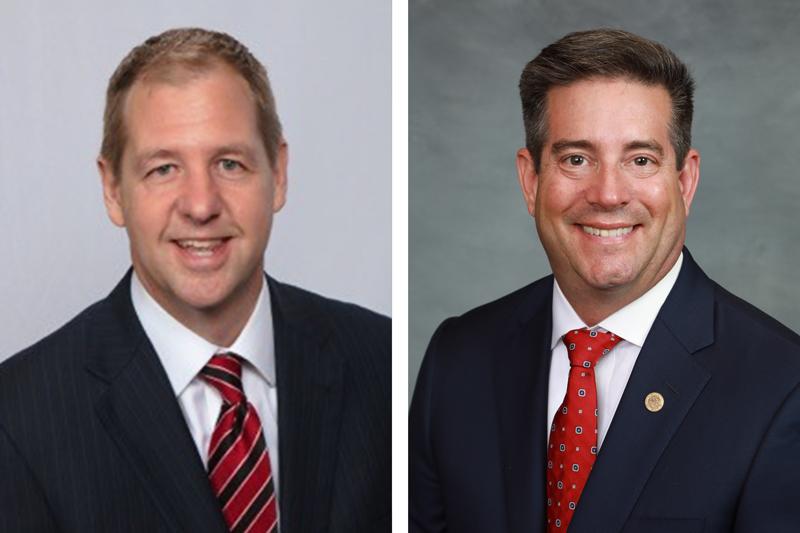
Mel Black of Raleigh has been elected as Chair of the North Carolina Real Estate Commission and Jeff Malarney of the Outer Banks as Vice Chair. Their terms began on August 1, 2022.
Mel Black was appointed to the Commission by Governor Cooper in 2019. As a real estate and appraisal educator, Mr. Black develops and delivers real estate curriculum for the Colibri Group. As an attorney in private practice with Everett Gaskins Hancock, LLP, he focuses on administrative law and occupational licensing. Mr. Black is a third-generation broker and second-generation appraiser in North Carolina. He has been licensed as a broker since 1988 and certified as an appraiser since 1991.
Mr. Black is the former Executive Director of the North Carolina Appraisal Board and former Education and Examination Officer with the North Carolina Real Estate Commission.
He has been elected to multiple national positions, including president of the Association of Appraiser Regulatory Officials, member of The Appraisal Foundation Advisory Council and its State Regulator Advisory Group, and member of the Board of Directors of the Council on Licensure, Enforcement and Regulation. For his service to North Carolina, Mr. Black was inducted into the Order of the Long Leaf Pine.
Mr. Black was named Educator of the Year by the North Carolina Real Estate Educators Association and received the Larry A. Outlaw Excellence in Real Estate Education Award from the North Carolina Real Estate Commission.
He holds a Juris Doctorate from the North Carolina Central University School of Law, an Educational Specialist degree from Appalachian State University, a Masters of Education from Winthrop College, and a Bachelor’s degree from the University of the State of New York. Mr. Black and his children, Andrew and Mari, are based in Raleigh.
Jeff Malarney, a former member of the Real Estate Commission, was reappointed to the Commission in 2018 by Governor Roy Cooper. He has practiced law in the Outer Banks for over 27 years and is a principal of the Law Offices of Jeff Malarney, PLLC. He is also a licensed real estate broker and property insurance agent.
A Commander (ret.) of the United States Navy Judge Advocate Corps, he is a former Special Assistant United States Attorney, past president of the North Carolina Vacation Rental Manager’s Association, and past chairman of the Outer Banks Chamber of Commerce.
Malarney founded and operated a mortgage brokerage company, an insurance agency, and created H20BX Waterpark in Currituck, North Carolina. Malarney holds a JD from Wake Forest University School of Law and BA (cum laude) in Economics and Management from Albion College.

Leonard C. “Len” Elder Named Director of Education and Licensing

Leonard C. “Len” Elder has been named Director of Education and Licensing for the Commission, effective June 29, 2022. Elder joined the Commission as Education and Development Officer in 2019.
Elder has a B.A. in both Speech Communication and Political Science & Economics, and a law degree from Capital University Law School. Len is a resident of Cary, North Carolina with his wife, Alexandra.
After several years in the private practice of law and then serving as Vice President of a mortgage company, Elder embarked on a career in adult education, specializing in real estate education. During his career, he has served as the Lead Instructor and Curriculum Developer for schools of real estate, and for several years, had his own course creation company.
Elder brings to the position 25 years of experience directing, planning, implementing and evaluating real estate education. He has developed standards and training for the delivery of real estate educational courses approved by the Commission. He has countless hours of live classroom experience in Prelicensing, Postlicening and Continuing Education. He has also written and taught multiple courses involving real estate and related legal issues.
He holds both the Gold Standard Instructor (GSI) and the Distinguished Real Estate Instructor (DREI) designations from the Real Estate Educators Association. He is also the recipient of the National Real Estate Instructor of the Year from the national Real Estate Educators Association (REEA), the North Carolina Real Estate Instructor of the Year from the North Carolina Real Estate Educators Association, and was recognized as the national course author of the year by REEA.
Elder has served as Past President of the North Carolina Real Estate Educators Association (NCREEA) and is the recipient of the Larry A. Outlaw Excellence in Education Award from the North Carolina Real Estate Commission. Earlier this year, REEA honored Elder with the first ever Dedication to Excellence Award recognizing over a decade of dedication and service to real estate education.
The primary responsibility of the Director of Education and Licensing is to plan and direct the Commission’s education, examination, and licensing programs and operations statewide.
Disciplinary Actions
CAROLINA TRACE GATED PROPERTIES LLC (SANFORD) – By Consent, the Commission suspended the broker license of Carolina Trace Gated Properties LLC for a period of 12 months, effective July 1, 2022. The Commission then stayed the suspension in its entirety. The Commission found that the Firm failed to verify the advertising of a broker affiliated with the Firm, resulting in listings advertised with inaccurate square footage figures.
FATHOM REALTY NC LLC (CHARLOTTE) – By Consent, the Commission reprimanded Fathom Realty NC LLC, effective June 20, 2022. The Commission found that the Firm was the listing firm for the sale of a residential property. The individual listing agent failed to verify the property’s septic permit and advertised the property as having four bedrooms when the septic permit specified three bedrooms. The listing agent has entered into a settlement with the 2019 buyer to the buyer’s satisfaction and the buyer has now sold the property.
ALVARO JOEL VILLARROEL GOMEZ (CHARLOTTE) – By Consent, the Commission revoked the broker license of Mr. Gomez effective July 1, 2022. The Commission found that in January 2022, Mr. Gomez submitted an Affidavit for Name Change along with a NC Court Order for the name change. Mr. Gomez has not had a legal name change and knowingly submitted invalid and fraudulent documents to the Commission.
C JON HINES (CHARLOTTE) – Following a hearing, the Commission suspended the broker license of Mr. Hines for thirty-six months effective July 1, 2022, provided however, that the first twelve months shall be active and the remaining twenty-four months shall be stayed. Mr. Hines shall not hold himself out to be a broker-in-charge or become broker-in-charge eligible for a period of five years from July 1, 2022. The Commission also withdrew Mr. Hines’ instructor approval for a period of three years effective July 1, 2022. The Commission found that Mr. Hines, as broker-in-charge of a Housemax LLC, altered pre-approval letters and did not obtain approval from the lender to alter the pre-approval letters. Mr. Hines also failed to provide all firm transactional records as requested by the Commission’s investigator.
HOUSEMAX LLC (CHARLOTTE) – Following a hearing, the Commission permanently revoked the firm license of Housemax LLC effective July 1, 2022. The Commission found that Mr. Hines, as broker-in-charge of the Firm, altered pre-approval letters and did not obtain approval from the lender to alter the pre-approval letters. The Firm also failed to provide all firm transactional records as requested by the Commission’s investigator.
JOSEPH ROBERT KENDRICK (BURGAW) – By Consent, the Commission suspended the broker license of Joseph Robert Kendrick for a period of 12 months, effective July 15, 2022. The Commission then stayed the suspension in its entirety. The Commission found that Mr. Kendrick, acting as the broker-in-charge of a firm, also acted as the listing agent under a limited service agreement. Mr. Kendrick advertised the square footage of the subject property and the bedroom count based on his seller client’s assertions and without independently verifying the information by measuring the property or attempting to pull the septic permit. The seller of the subject property also made renovations to it and Mr. Kendrick failed to verify whether any required permits were pulled prior to listing. A buyer went under contract to purchase the subject property and discovered, during their due diligence, that a septic permit could not be found and that permits were not pulled during the renovation. The buyer then terminated the contract. The subject property went under contract two more times prior to Mr. Kendrick updating the MLS advertisement to reflect the septic and permit issues.
WILLIAM R MONCURE (RALEIGH) – By Consent, the Commission suspended the broker license of William R Moncure for a period of 6 months, effective July 1, 2022. The Commission then stayed the suspension in its entirety. The Commission found that Mr. Moncure, acting as a listing agent, advertised a property as a five-bedroom house based on the seller’s representation. Mr. Moncure failed to discover and disclose that the property was permitted for a three-bedroom septic. A buyer under contract to purchase the property discovered the discrepancy and the seller refused to refund the buyer’s $15,000 due diligence fee until the buyer retained counsel. Upon discovering that the permit was only for a three-bedroom septic, Mr. Moncure immediately revised his MLS listing. He also called the Commission to advise on the matter and seek guidance. The subject property has since been sold with the correct MLS listing and disclosures in place. Mr. Moncure has also entered into a civil settlement with the first buyer to the buyer’s satisfaction.
CHARLES C POWELL II (CHARLOTTE) – The Commission accepted the permanent voluntary surrender of the broker license of Mr. Powell effective July 1, 2022. The Commission dismissed without prejudice allegations that Mr. Powell violated provisions of the Real Estate License Law and Commission rules. Mr. Powell neither admitted nor denied misconduct.
ALFRED S RUSHATZ (SANFORD) – By Consent, the Commission suspended the broker license of Alfred S. Rushatz for a period of 12 months, effective July 1, 2022. The Commission then stayed the suspension in its entirety. The Commission found that Mr. Rushatz as qualifying broker and broker-in-charge of a firm, failed to verify the advertising of a broker affiliated with Mr. Rushatz’s firm. This resulted in listings advertised with inaccurate square footage figures. Mr. Rushatz engaged in the practice of law in North Carolina without a law license when he prepared a deed in a real estate transaction.
CHERIE L SCHULZ (RICHLANDS) – The Commission accepted the voluntary surrender of the broker license of Ms. Schulz effective July 20, 2022. The Commission dismissed without prejudice allegations that Ms. Schulz violated provisions of the Real Estate License Law and Commission rules. Ms. Schulz neither admitted nor denied misconduct.
CHERIE SCHULZ REALTY FIRM INC (RICHLANDS) – The Commission accepted the voluntary surrender of the broker license of Cherie Schulz Realty Firm Inc. effective July 20, 2022. The Commission dismissed without prejudice allegations that Cherie Schulz Realty Firm Inc. violated provisions of the Real Estate License Law and Commission rules. Cherie Schulz Realty Firm Inc. neither admitted nor denied misconduct.
USREALTY.COM LLP (BURGAW) – By Consent, the Commission suspended the broker license of USRealty.com LLP for a period of 12 months, effective July 15, 2022. The Commission then stayed the suspension in its entirety. The Commission found that the Firm acted as the listing agent under a limited service agreement. The Firm advertised the square footage of the subject property and the bedroom count based on its seller client’s assertions and without independently verifying the information by measuring the property or attempting to pull the septic permit. The seller of the subject property also made renovations to it and the Firm failed to verify whether any required permits were pulled prior to listing. A buyer went under contract to purchase the subject property and discovered, during their due diligence, that a septic permit could not be found and that permits were not pulled during the renovation. The buyer then terminated the contract. The subject property went under contract two more times prior to the Firm updating the MLS advertisement to reflect the septic and permit issues. The Firm has since created additional training and policies for its agents.
Staff Appearances
Dee Bigelow, Information Officer, spoke at the Greenridge Realty meeting on July 19.
Employment Opportunities Available
Are you interested in joining the staff of the North Carolina Real Estate Commission? From time to time, employment opportunities become available. They are posted on the Commission’s website under the “About Us” tab.
Click here for more information.
Opening a Real Estate Broker Trust Account
The Law:
G.S. 93A-6(g) states that “a broker’s trust or escrow account shall be a demand deposit account in a federally insured depository institution lawfully doing business in the State which agrees to make its records of the broker’s account available for inspection by the Commission’s representatives”
North Carolina Real Estate Commission Rules:
21 NCAC 58A .0117 (b) states that “a trust or escrow account shall satisfy the requirements of G.S. 93A-6(g) and shall be designated as a “Trust Account” of “Escrow Account”. All bank statements, deposit tickets and checks drawn on said account shall bear the words “Trust Account” or “Escrow Account”. A trust account shall provide for the full withdrawal of funds on demand without prior notice and without penalty or deduction to the funds.
21 NCAC 58A .0117 (4)(c) states “a broker may maintain a maximum of one hundred ($100.00) in company funds in the trust account for the purpose of paying service charges incurred by the account. In the event that the services charges exceed one hundred dollars ($100.00) monthly, the broker may deposit an amount each month sufficient to cover the service charges. A broker shall maintain a separate ledger for company funds held in the trust account identifying the date, amount and running balance for each deposit and disbursement.”
Why do Brokers sometimes have difficulty opening a Real Estate Broker Trust Account at a bank or federally insured depository institution?
Sometimes a broker runs into difficulty opening a trust or escrow account at a bank or federally insured depository institution. Most often the problem is a result of the banker requiring the broker to provide them with a formal trust agreement.
So why the confusion? It is fairly common for individuals and families to create a formal trust agreement for the purpose of distributing assets upon an individual’s death. This may be done to protect property in an estate or to avoid probate. The person who manages a trust on behalf of a beneficiary is a trustee. So, the banker hears you want to open a trust account and then requires that the broker provide a written trust agreement to establish the account.
In real estate brokerage, the broker is a fiduciary to the people whose money is held in the trust or escrow account. Though this fiduciary relationship exists, the broker is not a “trustee” and there is no formal trust document.
When Establishing a Trust or Escrow Account – Give the Following Information to the Banker.
- Ask to open a business checking account (this is a demand deposit account).
- Verify that the account is “federally insured”.
- Have the banker designate the account(s) as a “Trust Account” or Escrow Account” by adding the designation to all bank statements, deposit tickets and all checks drawn on the account.
- Explain that no written trust agreement is required.
The broker may need to tell the Banker that the account is similar to an attorney trust account, in that there is no trust agreement.
If the broker provides the preceding information and the banker still insists on requiring a formal trust agreement, the broker may want to consider using another bank or depository institution. There are probably tens of thousands of real estate trust or escrow accounts in the State of NC, so it should be relatively easy to find a banker to open your real estate broker trust account.
Other Considerations or Recommendations
- The broker can open and maintain the account with a maximum of $100 of broker or company funds for the purpose of paying service charges incurred by the account. However, the broker does not have to have any personal or company funds in the account. If the firm also maintains an operating account (non-trust acct) at the bank, the banker may be able to deduct any service fees incurred from the trust account from the non-trust operating account.
- Many brokers that engage in property management prefer to open several trust or escrow accounts. Often brokers decide to open separate accounts for tenant security deposits and rents. Many brokers have found it beneficial to make the checks different colors, as a way to easily identify the account.
NCREC: Learning Management System
The Commission has established an online training portal to deliver courses required by License Law and Commission rules and provide valuable information to brokers, education providers and instructors. The new platform is separate from the Commissions website and can be found at learn.ncrec.gov.
As a first time user, you will need to register at learn.ncrec.gov. Your login credentials for learn.ncrec.gov are separate from your other login credentials in existence with the Commission.
Courses currently available in the learning management system include the following:
Commission Rule 58A .0110(e) requires that brokers who request BIC-Eligible Status either complete the 12 hour Broker-in-Charge course within one year prior to submitting the Request for BIC-Eligible Status and/or BIC Designation (Form REC 2.25) or complete the course within 120 days after becoming BIC-Eligible.
The 12 Hour Broker-in-Charge course titled, The Great BIC Journey: Learning to Serve the People and Places of North Carolina is available on the Commission’s new platform at learn.ncrec.gov. A link to the course is also available on the Commission’s website under the Education Tab.
The Great BIC Journey is divided into three 4-hour modules. There are interactive exercises involving the rules and statutes, images, narrated slides and practical applications of the information. There is no final exam required; however, students must complete individual assessments throughout the course.
Brokers who successfully complete the 12- Hour Broker-in-Charge course will receive 4 hours of continuing education elective credit.
Commission Rule 58A .0110(g)(9) requires that a designated BIC complete the Commission’s Basic Trust Account Procedures course within 120 days of assuming responsibility for a trust account.

Taking the Right Path for Trust Accounts is the Basic Trust Account Procedures course. The course is divided into 14 separate modules and covers topics such as trust account requirements, trust account responsibilities, depositing and disbursement of funds, record keeping and audits. The course takes students 4 hours to complete and is full of practical applications including the process of account reconciliation. There is no final examination for the course; however, students do complete assessments at the end of each module.
You can find a link to register for the course at learn.ncrec.gov under the Education Tab. Brokers who successfully complete the course will receive 4 hours of continuing education elective credit.
INSTRUCTOR DEVELOPMENT WORKSHOPS
Instructors are required by Rule 58H .0306 to complete 6 hours of an instructor educational development program each year in order to renew their instructor approval. There are several ways that instructors can obtain this credit such as attending the Commission’s Spring Educators Conference or the Real Estate Educators Association conferences and workshops, including the NCREEA Fall Conference.
In order to provide instructors with additional options, the Commission has added two 3-hour instructor development workshops to its online learning portal. These courses do not provide CE credit.

Fundamental Principles on the Road to Better Teaching includes information that helps instructors and education providers comply with the requirements of Rule 58H .0304 regarding instructor conduct and performance. It provides guidance on crafting learning objectives, developing relevancy for the students, using visual imagery and assessing the students.

Teaching is Not a Spectator Sport provides guidance, ideas and practical tips for increasing student engagement. The engagement of students is critical to learning, whether teaching in a live, synchronous, or distance format.
All of the courses are self-paced asynchronous courses and must be completed within 30 days of course registration. Regardless of which courses a broker takes, here are some practical tips that will make their learning adventure more enjoyable in the online learning portal.
- In order to save their progress and return to the course at another time, a broker must log out of the portal in order for their work to be saved.
- These courses contain a lot of content and features. They do not work well on mobile devices such as a cell phones or hand held-devices. We recommend that you take these courses on a computer or laptop.
- Brokers should not switch devices while taking the course. A broker should finish the course on the same type of device they used when they began the course.
The Commission is excited to bring information to brokers and instructors while using a new, convenient platform.
Links to all of the courses referenced in this article are provided under the Education Tab on the Commissions website. For more information, you may contact the Education and Licensing Division at LS@ncrec.gov or 919.875-3700.