Bulletin Search
BICs: Do your licensees have multiple affiliations?
Are you a Broker-in-Charge (BIC)? Do you have affiliated licensees? Have you ever wondered if your licensees have multiple affiliations?
The Broker-in-Charge Login now enables BICs to view all affiliations of the licensees under their supervision. To determine whether or not your affiliated licensees have multiple affiliations, log into your license record on the Commission’s website:
- go to www.ncrec.gov;
- click on BIC Login;
- enter your License number and Pin number;
- click on Licensees Under Your Supervision;
- review Additional Affiliations column;
- click on a licensee with an Additional Affiliation; and
- review the Details page.
Additionally, once a licensee has added or removed an affiliation, all BICs for the licensee will receive a notice. This notice will indicate the licensee has made a change to one or more of their affiliations.
For more information, contact the Education and Licensing Division at LS@ncrec.gov or 919.875.3700.
Nomination deadline for 2021 Outlaw Award is January 15
The Commission is soliciting nominations for the 2021 Larry A. Outlaw Excellence in Education Award until Friday, January 15, 2021. Click here to download the nomination form, which includes detailed information about selection criteria and the nomination process. Questions and nominations should be directed to outlawaward@ncrec.gov.
Regulatory Affairs Case Study: You’ve heard the expression “Measure Twice, Cut Once”? This is a story of “Read Twice, Act Once!”
By Sheryl B. Graham, Consumer Protection Officer
After a transaction closed, the seller of the property filed a complaint with the Commission against the buyer’s agent. The buyer agent had been present at the nearly vacant property with the buyer during the home inspection. While there, the buyer agent texted the listing agent and asked if the seller was going to sell any of the items in the garage. The listing agent promptly answered via text “LOL. He doesn’t want to sell anything.” The buyer agent replied “Awesome!! We will pick through it then.” The listing agent followed up with another text stating “Hey! The seller said he isn’t interested in selling anything”
That evening, the seller contacted the listing agent to say two quilts were missing and things in the garage were “rummaged” through and set aside as if someone was coming back for more. The home inspection was the only scheduled appointment that day and the listing agent remembered the texts with the buyer agent earlier that day. The listing agent texted the buyer agent about the missing items and explained the seller wanted the items back within the hour or he would notify the police. When the buyer agent returned the items that evening, the seller was waiting and videotaped the return.
Although the identified items were brought back, the seller still expressed his distrust and questioned if everything was returned. During the investigation, the buyer agent explained she occasionally misreads information and that she read the listing agent’s text as saying “He isn’t interested in keeping anything.” The buyer agent stated she did not read the follow-up text from the listing agent, thinking it repeated the same message, until she had left the property with the items.
Consumers put their trust in brokers not only to guide them through transactions, but to safeguard their real and personal property. If a broker knows that they need to read something twice to ensure accuracy or ask someone to verify their statement or meaning, then do just that. In this case, reading twice before acting once would have saved a lot of frustration, embarrassment and distrust.
Once the buyer agent’s broker-in-charge learned of the issue, the Broker-in-charge stepped in and handled the remainder of the transaction, put the buyer agent on probation, and required the agent to take an ethics class. The Commission cautioned the buyer agent to exercise greater care to communicate clearly with other parties in a transaction and to safeguard personal items in properties listed for sale. All brokers can learn from this case to be clear when communicating via text. Texting on the fly can lead to misunderstandings and incomplete thoughts. Reread the communication and confirm your understanding or call the other person before taking action.
Appearances
Danielle Alston, Consumer Protection Auditor, spoke at Allen Tate Companies’ Business Meeting on December 1.
Stephen Fussell, Chief Consumer Protection Officer, spoke at the Jacksonville Board of Realtors meeting on December 17.
Disciplinary Actions
BRITTANY NICOLE JOHNSON (JACKSONVILLE) – Following a hearing, the Commission revoked the license of Ms. Johnson effective October 16, 2019. The Commission found that Ms. Johnson failed to provide a final tenant security deposit accounting to the tenant within 30 days of her lease termination. The Commission also found that during the investigation Ms. Johnson failed to respond to multiple Letters of Inquiry and all attempted communications.
MICHAEL GENE GREENE (ARDEN) – The Commission accepted the voluntary surrender of the broker license of Mr. Greene effective December 11, 2019. The Commission dismissed without prejudice allegations that Mr. Greene violated provisions of the Real Estate License Law and Commission rules. Mr. Greene neither admitted nor denied misconduct.
DAWN CROUSE CARRIER (NORTH WILKESBORO) – By Consent, the Commission permanently revoked the broker license of Ms. Carrier effective March 18, 2020. The Commission found that in 2015, Ms. Carrier was found guilty of 24 felony counts of obtaining property by false pretenses. In 2018, she was found guilty of two felony counts of obtaining property by false pretenses. As a paralegal, Ms. Carrier took money from the law firm where she was employed by falsifying documents to either increase the amount of commission checks being paid to her husband’s real estate firm above the amount entitled or to pay commissions when no commission was due. Ms. Carrier failed to report these convictions to the Commission as required.
RACHEL L ALLES (CHARLOTTE) – By Consent, the Commission reprimanded Ms. Alles effective June 17, 2020. The Commission found that Ms. Alles, as the broker-in-charge of a firm, failed to properly supervise a provisional broker (PB) who acted as the listing agent in a residential transaction. The subject property went under contract with a closing date on June 27. The contract had a contingency that the buyers must sell their property prior to closing on the subject property. On June 7, the buyer’s agent notified the PB that the closing had been delayed and that the subject property would therefore not close as scheduled on June 27. The PB failed to inform the seller client of this information until June 24. The seller client then incurred fees for storage expenses due to the delayed closing. The Commission notes that the seller has been reimbursed for storage expenses.
HIGHER TECH REALTY NC LLC (CHARLOTTE) – By Consent, the Commission reprimanded Higher Tech Realty effective June 17, 2020. The Commission found that Higher Tech Realty NC LLC, was the listing firm for a residential property in which a provisional broker (PB) acted as the listing agent. The subject property went under contract with a closing date on June 27. The contract had a contingency that the buyers must sell their out-of-state property prior to closing on the subject property. On June 7, the buyer’s agent notified the PB that the closing had been delayed and that the subject property would therefore not close as scheduled on June 27. The PB failed to inform the seller client of this information until June 24. The firm’s seller client then incurred fees for storage expenses due to the delayed closing. The Commission notes that the seller has been reimbursed for storage expenses.
DORIS E NIXON (THOMASVIILLE) – The Commission accepted the voluntary surrender of the broker license of Ms. Nixon effective June 18, 2020. The Commission dismissed without prejudice allegations that Ms. Nixon violated provisions of the Real Estate License Law and Commission rules. Ms. Nixon, neither admitted nor denied misconduct.
ROBERT S COHEN (FAYETTEVILLE) – By Consent, the Commission reprimanded Mr. Cohen effective July 1, 2020. The Commission found that, while acting as a real estate school director, Mr. Cohen failed to supervise School instructors and ensure compliance with Commission rules regarding School records. A review of School records discovered incomplete attendance records as well as misreporting of class completions for several licensees. The School failed to maintain all rosters for its courses. Class rosters that were maintained show that many were not reported to the Commission within seven days of course completion. Due to late reporting by the School, some licensees were placed on inactive status by the Commission when, in fact, they were up-to-date on their continuing education prior to the deadline.
TERRY FARR SCHOOL OF REAL ESTATE (FAYETTEVILLE) – By Consent, the Commission reprimanded the School effective July 1, 2020. The Commission found that the director failed to supervise School instructors and ensure compliance with Commission rules regarding School records. A review of School records discovered incomplete attendance records as well as misreporting of class completions for several licensees. The School failed to maintain all rosters for its courses. Class rosters that were maintained show that many were not reported to the Commission within seven days of course completion. Due to late reporting by the School, some licensees were placed on inactive status by the Commission when, in fact, they were up-to-date on their continuing education prior to the deadline.
KIMBERLY ANN BENNETT (FAYETTEVILLE) – By Consent, the Commission suspended the broker license of Ms. Bennett for a period of 2 months effective July 1, 2020. The Commission found that, while acting as a real estate school instructor, Ms. Bennett allowed a student to take two postlicensing courses, which overlapped, within a ten day period. This violated the Commission rule prohibiting students from being enrolled in more than 30 instructional hours within a seven day period. Ms. Bennett further allowed School records to misrepresent to the Commission as to when and with whom the student took a postlicensing course.
KR PROPERTY GROUP (CARY) – The Commission accepted the voluntary surrender of the broker license of KR Property Group effective July 1, 2020. The Commission dismissed without prejudice allegations that KR Property Group, violated provisions of the Real Estate License Law and Commission rules. KR Property Group, neither admitted nor denied misconduct.
CYDNEY WHITE METZ (CHARLOTTE) – By Consent, the Commission suspended the broker license of Ms. Metz for a period of 12 months effective September 15, 2020. The Commission then stayed the suspension in its entirety and placed Ms. Metz on probation until September 15, 2021. The Commission found that Ms. Metz acted as the listing agent for a property that went under contract with a closing date set for June 27. The contract had a contingency that the buyers must sell their property prior to closing on the subject property. On June 7, the buyers’ agent notified Ms. Metz that the closing had been delayed and that the subject property would therefore not close as scheduled on June 27. Ms. Metz failed to inform her seller client of this information until June 24. Ms. Metz’s seller client incurred fees for storage expenses due to the late notice. The Commission notes that the seller has been reimbursed for storage expenses.
KMBJ ENTERPRISE INC (FAYETTEVILLE) – By Consent, the Commission revoked the license of KMBJ Enterprises Inc. effective September 15, 2020. The Commission found that a review of KMBJ Enterprises Inc.’s trust accounts found: check, deposit slips, and ledgers failed to contain identifying information as required by Commission rules; trust account reconciliations were not being performed; lack of trial balances; and that not all bank activity was being posted on the ledgers. Furthermore, an owner was holding two tenant security deposits while the lease stated that the firm was holding these funds. Finally, the management agreement with one owner stated that the firm was managing one property when, in fact, it was managing three separate properties on the owner’s behalf.
JENNIFER MICHELLE RAMSEY (HUBERT) – By Consent, the Commission permanently revoked the license of Ms. Ramsey effective October 21, 2020. The Commission found that Ms. Ramsey failed to comply with Commission staff’s initial request for records. In October 2019, the trust account records for Ms. Ramsey’s firm were reviewed and several deficiencies were discovered including: ledgers and journals lacking required identification information, failure to perform reconciliations, deposit slips and bank statements were not designated “trust” or escrow”, lack of an audit trail, deficit spending, and shortages in the account. In a separate matter, a civil judgment was issued against Ms. Ramsey due a breach of her management agreement. In February 2020, the Commission sent a Letter of Inquiry to Ms. Ramsey to which she failed to respond. In May 2020, a Commission investigator travelled to Ms. Ramsey’s address of record where she refused to speak with the investigator.
ALLISON LEIGH CABE (KITTY HAWK) – The Commission accepted the voluntary surrender of the broker license of Ms. Cabe effective October 21, 2020. The Commission dismissed without prejudice allegations that Ms. Cabe violated provisions of the Real Estate License Law and Commission rules. Ms. Cabe neither admitted nor denied misconduct.
ALVAREZ JUAN POWELL II (CHARLOTTE) – By Consent, the Commission suspended the broker license of Mr. Powell II for a period of 12 months effective November 1, 2020. The Commission found that in applying for his real estate license, Mr. Powell II disclosed five criminal convictions including one misdemeanor cocaine possession conviction. Mr. Powell II signed a consent order in order to obtain his license. In November 2019, Mr. Powell II reported a second (felony) conviction for possession of cocaine and claimed that a friend left a bag of cocaine on the passenger seat of his car but a magistrate’s order indicated that “individually packaged baggies of cocaine weight 6.1 grams” were found. Mr. Powell II was sentenced to 4-14 months of imprisonment which was suspended and was placed on 1 year of supervised probation and ordered to complete 24 hours of community service.
BRANDON SCOTT LOCKARD (CHARLOTTE) By Consent, the Commission reprimanded Mr. Lockard effective December 8, 2020. The Commission found that Mr. Lockard acted as a buyer agent in a residential property purchase. The Buyer sent funds to closing via ACH transfer rather than by wire, which delayed funding and recording. Mr. Lockard gave the keys for the subject property to the Buyer at the signing and told the Buyer not to enter the subject property until the closing documents had been recorded. The Buyer began moving into the subject property on the date of signing, which was two days prior to funding and recording of the transaction. The Commission notes that the seller, upon notice, allowed the buyer to remain in the property prior to deed transfer.
ERICKA JANAE HOLLINGSWORTH (HOPE MILLS) – Following a hearing, the Commission reprimanded Ms. Hollingsworth effective December 10, 2019. The Commission found that Ms. Hollingsworth signed non-disclosure and confidentiality agreements while employed as a property manager for a firm, obtained client contact information as part of her employment with the firm, and, following termination, used the client information to solicit those clients for a property management firm she opened. The Commission also found that Ms. Hollingsworth, with no actual knowledge of the facts, falsely represented that her former firm had overloaded staff with clients following her termination.

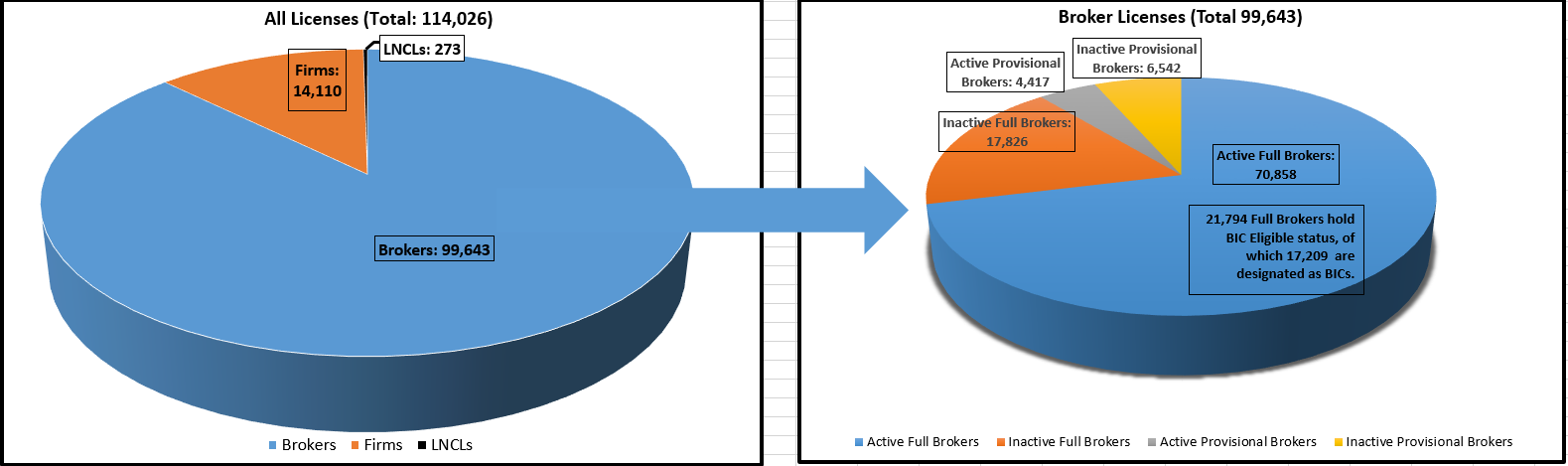
How to determine if you have BIC Eligible status
Have you ever wondered what Broker-in-Charge (BIC) Eligible status means? Do you know if you hold BIC Eligible status or if you meet the requirements to attain it?
To determine whether you hold BIC Eligible status, log into your license record on the Commission’s website:
- go to www.ncrec.gov;
- click on Licensing;
- click on Licensee Login; and
- click on View/Update License Record.
The View/Update Information page shows whether you currently hold BIC Eligible status. If you do, Yes will appear beside BIC Eligible status. If you do not currently hold the status, No will appear beside BIC Eligible status.
In order to qualify for BIC Eligible status, a broker must:
- hold an active license;
- have obtained at least two years of real estate brokerage experience equivalent to 40 hours per week within the previous five years;
- submit the Request for BIC Eligible Status and/or BIC Designation form (REC 2.25); and
- complete the 12-hour BIC Course within one year before submission of Form 2.25 or within 120 days after submission of Form 2.25.
A broker must first have BIC Eligible status to be designated as a BIC. A broker who has BIC Eligible status may step in and out of active BIC designation by submitting the Request for BIC Eligible Status and/or BIC Designation form (REC 2.25).
BIC Eligible status may be maintained indefinitely by a broker who:
- renews their broker license between May 15 and June 30 every year; and
- completes the Broker-in-Charge Update (BICUP) course and a four-hour Commission- approved continuing education elective course by June 10 each year.
See Commission Rule 58A .0110 for a full explanation of BIC Eligible status and BIC designation. For more information or to ask a question, contact the Education and Licensing Division at LS@ncrec.gov or 919.875.3700.
Regulatory Affairs Case Study: Get Answers First
By Sheryl B. Graham, Consumer Protection Officer
An unsuccessful buyer who submitted an offer to purchase a beach-front property through his buyer agent filed a complaint with the Commission against the listing agent.
Before showing the property, the buyer agent texted the listing agent asking questions about the property. She asked if there was any storm damage from a prior hurricane, the location of the set-back lines, and if a structure could be rebuilt on the lot if the current structure was extensively damaged. The listing agent answered some of the questions via text and stated she was waiting for answers to the remaining questions. There was no response from the listing agent regarding whether or not the lot would be buildable if the structure were to be heavily damaged. The listing agent and the buyer agent also spoke by telephone. The buyer agent recalled the listing agent stating the damage from a prior storm was mostly cosmetic and was being repaired. The listing agent recalled telling the buyer agent to contact the local Division of Coastal Management, which carries out the state’s Coastal Area Management Act (aka CAMA) requirements, regarding the property setback lines.
The buyer submitted an offer to purchase without receiving additional answers or verifying information. After the inspections and survey were completed, the buyer contacted a CAMA representative regarding the setback lines. The buyer learned the lot was “non-conforming”, meaning the structure could not be rebuilt in the existing footprint if it was damaged beyond 50%. According to the CAMA office, a lot classification can change with the location of the first stable vegetation line in relationship with the ocean. Changes can occur due to storms, hurricanes, and acts of nature. Therefore setback lines and lot classifications of beach-front properties should be verified with current information. The standard setback from the oceanfront is a minimum of 60’ from the first stable line of vegetation. If the house or structure is within 60’, the house is “non-conforming,” meaning that repairs and maintenance can be made to the property of up to 50% of the structure (whether caused by storm, hurricane, flood, etc.). If the repairs / maintenance are for more than 50% of the structure, that is deemed “development” and must be approved through new construction guidelines and meet the current requirements. A standard survey does not indicate the location of setback lines and should not be relied upon to determine if a lot is non-conforming or not.
The buyer was not interested in continuing with the purchase and although it was past the due diligence (DD) date, the seller released the earnest money deposit, but not the DD fee. The seller updated the Residential Property Owners Association Disclosure and the listing agent revised the MLS to reflect the information about the non-conforming lot. The buyer filed a complaint against the listing agent for failure to disclose a material fact.
The North Carolina Real Estate Commission (NCREC) publication Purchasing Coastal Real Estate in North Carolina advises consumers: “…If you are working with a licensed real estate broker, the broker has the duty to disclose material facts that the broker knows or reasonably should know. Although real estate brokers may not always know erosion rates or setback location for particular oceanfront properties, they should advise you of the possibility of erosion and direct you to available sources of information…”. It further states: “…Purchasers should determine if the lot and building presently meet the setback for new construction and [if the lot is] eligible for a replacement building, keeping in mind the risk that erosion may make the lot unbuildable in the future.”
During investigation of the case, both the buyer agent (a provisional broker) and her broker-in-charge were added as Respondents. The Commission cautioned the listing agent to discover and disclose material facts and features about properties prior to listing. The Commission cautioned the buyer agent to discover and disclose material facts about a property prior to assisting a buyer with submitting an offer. The Commission cautioned the buyer agent’s broker-in-charge regarding supervision of provisional brokers and training to discover and disclose material facts. In this case, confirming answers to the buyer’s questions prior to submitting an offer would have saved the parties time, money and headaches. Properties in particular markets, such as oceanfront areas, have features and nuances unique to their location. Brokers representing clients in these areas should know, disclose and communicate those characteristics.
For further information, visit:
- the NC Department of Environmental Quality, Division of Coastal Management: https://deq.nc.gov/about/divisions/coastal-management/about-coastal-management
- the NCREC website https://www.ncrec.gov/Publications/Pubs to access a copy of our Q&A on Purchasing Coastal Real Estate brochure.
Appearances
Charlie Moody, Legal Counsel, spoke at the Greensboro Regional Realtors Association’s First Tuesday Membership Meeting on November, 3.
Pete Myers, Information Officer, spoke at eXp Realty LLC’s NC Broker Meeting on November 19
Disciplinary Actions
NOAH CHRISTOPHER GEORGE (HENDERSONVILLE) – By Consent, the Commission reprimanded Mr. George effective October 16, 2019. Mr. George timely reported his April 23, 2019, conviction of misdemeanor sexual battery. He received 60 days of confinement, which was suspended and instead placed on supervised probation for one year. The incident occurred during a personal New Year’s Eve outing, involved a woman he previously had known, and occurred while both were intoxicated.
PAULA MAE WHITTED (CLYDE) – By Consent, the Commission reprimanded Ms. Whitted effective October 16, 2019.The Commission found that on or about May 23, 2019, Ms. Whitted attended the General Update Course at JY Monk/Kaplan R.E. Education in Waynesville, North Carolina and an elective course at the same school. The instructor noted that Ms. Whitted’s behavior changed from inquisitive to “confrontational” during the fourth hour of the first class and that Ms. Whitted was drinking from a large takeout cup. During the second class, she became increasingly disruptive. A student in the second class called the Waynesville Police Department because the student was concerned that Ms. Whitted was going to drive herself home, she was approached by a police officer at the end of class for questioning. The officer administered a “breath” test and was told to have someone pick her up. A criminal background search revealed Ms. Whitted has a DWI (Level 5) conviction in 2001.
SAMUEL S ANDERSON (LUMBERTON) – By Consent, the Commission suspended the broker license of Mr. Anderson for a period of 24 months. The Commission then stayed the suspension after a 3 month active suspension period. Mr. Anderson executed a purchase contract to sell vacant land, which he personally owned and failed to transfer title after receiving the full purchase amount from the buyer or by the date specified in the contract. Mr. Anderson instead used the purchase money as earnest money for a later executed purchase contract with the original buyer’s daughters to construct a home on the property. Mr. Anderson failed to construct the new home and the buyers won a civil judgment against him. Mr. Anderson then signed his name on an offer to purchase as the selling agent without an agency agreement in place with the buyer and failed to maintain a copy of all records in accordance with Commission rules. He also failed to present all offers to his seller clients and instead, presented two offers to a closing attorney who believed them to be fully executed when they were not. Mr. Anderson’s trust account was not labeled “trust” or “escrow” and the records were not properly maintained.
RODNEY R. CREECH (WILSON) – By Consent, the Commission revoked the license of Mr. Creech effective January 1, 2020.The Commission found that on or about March 2019, Mr. Creech was bidding on a judicial sale property against another potential buyer with the bidding going back and forth for weeks. On or about March 28, 2019, Mr. Creech called the other buyer’s agent and started “Tell your client if he is willing to pay me $2,000, I’ll have my offer go away.” The buyer agent conveyed the message to his buyer and recommended not to do so. The competing buyer called Mr. Creech directly and he first stated that his client instructed him to ask for the money before admitting that Mr. Creech “and his business partner” were buyers and that he was not representing a client when asking for payment.
HANS PROPERTY MANAGEMENT & REALTY (CHARLOTTE) – The Commission accepted the voluntary surrender of the firm license of Hans Property Management & Realty effective March 18, 2020. The Commission dismissed without prejudice allegations that Hans Property Management & Realty violated provisions of the Real Estate License Law and Commission rules. Hans Property Management & Realty neither admitted nor denied misconduct.
AMY BENSON LOGAN (SWANSBORO) – By Consent, the Commission reprimanded Ms. Logan effective April 1, 2020. The Commission found that on or about April 2018, Ms. Logan, acting as listing agent, falsely represented in the MLS that the subject property had a square footage of 4,230. In her MLS listing, she noted in the agent remarks that there was an inconsistency in the listed and taxed square footage of 3,431. Ms. Logan stated that she did her own measurements and made those available to the potential buyer. Her measurements were a three page, hand drawn outline of the property for sale with incorrect math at the bottom of the drawing stating a square footage of 4,216. The buyers bought the home without an appraisal and discovered that the actual square footage of the home was 3,271, a difference of over 950 square feet or a 29% gross error in size.
LIJUAN LISA HAN (CHARLOTTE) – By Consent, the Commission suspended the broker license of Han for a period of 2 years effective June 3, 2020.’The Commission then stayed the suspension in its entirety and place Ms. Han on probation until March 31, 2022. The Commission found that Ms. Han, as qualifying broker/broker-in-charge of TLC Realty Group Inc., acting as listing agent for a property that was being “flipped,” failed to disclose known material facts. The house went under contract and was terminated five times after home inspections for each of the five buyers revealed an underground storage tank, an unpermitted deck addition that was deemed structurally unsound, a sagging main support beam, an HVAC system that was installed in 2003 instead of within the last 0-5 years as stated in the RPOADS, active termites, and that the electrical and mechanical permits for the property were pending. Ms. HAN was apprised of the deficiencies with the house, but never updated the MLS to accurately reflect the known material facts or otherwise disclose the issues. She never advised her seller-client, who was also a licensee, to change the RPOADS from “No Representation” after any of the terminated contracts.
TLC REALTY GROUP INC (CARY) – By Consent, the Commission suspended the firm license of TLC Realty Group Inc. for a period of 2 years effective April 15, 2020. The Commission then stayed the suspension in its entirety and place TLC Realty Group Inc. on probation until March 31, 2022. The Commission found that TLC Realty Group Inc., as listing agent for a property that was being “flipped,” failed to disclose known material facts. The house went under contract and was terminated five times after home inspections for each of the five buyers revealed an underground storage tank, an unpermitted deck addition that was deemed structurally unsound, a sagging main support beam, an HVAC system that was installed in 2003 instead of within the last 0-5 years as stated in the RPOADS, active termites, and that the electrical and mechanical permits for the property were pending. The broker-in-charge was apprised of the deficiencies with the house, but never updated the MLS to accurately reflect the known material facts or otherwise disclose the issues. The broker-in-charge never advised her seller-client, who was also a licensee, to change the RPOADS from “No Representation” after any of the terminated contracts.
LIJUAN LISA HAN (CHARLOTTE) – By Consent, the Commission suspended the broker license of Ms. Han for a period of 2 years effective June 3, 2020. The Commission then stayed the suspension in its entirety. The Commission found that Ms. Han, acting as a qualifying broker of a firm, created the firm for compensation purposes only; therefore it had no designated broker-in-charge. Ms. Han then entered into Property Management Agreements on behalf of the firm, some even before it was licensed. A review of Ms. Han’s trust accounts found: that disbursements failed to identify their purpose; a failure to retain deposit tickets; a failure to maintain separate journals; lack of an audit trail; a failure to perform monthly reconciliations; and comingling. Ms. Han has since transferred all funds to a third party firm and no longer engages in property management.
JESSE THOMAS WILLIAMS III (GREENVILLE) – The Commission accepted the voluntary surrender of the broker license of Jesse Thomas Williams III effective June 17, 2020. The Commission dismissed without prejudice allegations that Jesse Thomas Williams III violated provisions of the Real Estate License Law and Commission rules. Jesse Thomas Williams III neither admitted nor denied misconduct.
CONWAY & WILLIAMS PROPERTIES INC (GREENVILLE) – The Commission accepted the voluntary surrender of the firm license of Conway & Williams Properties Inc., effective June 17, 2020. The Commission dismissed without prejudice allegations that Conway & Williams Properties Inc., violated provisions of the Real Estate License Law and Commission rules. Conway & Williams Properties Inc., neither admitted nor denied misconduct.
LARRY JAMES PARKER JR (ERWIN) – The Commission accepted the voluntary surrender of the broker license of Larry James Parker, Jr., effective June 17, 2020. The Commission dismissed without prejudice allegations that Larry James Parker, Jr., violated provisions of the Real Estate License Law and Commission rules. Larry James Parker, Jr., neither admitted nor denied misconduct.
RMG REALTY CO INC (ERWIN) – The Commission accepted the voluntary surrender of the firm license of RMG Realty Co., Inc., effective June 17, 2020. The Commission dismissed without prejudice allegations that RMG Realty Co., Inc., violated provisions of the Real Estate License Law and Commission rules. RMG Realty Co., Inc., neither admitted nor denied misconduct.
JONATHAN ALFORD MATTHEWS (RALEIGH) – Following a hearing, the Commission permanently revoked the broker license of Jonathan Alford Matthews effective October 1, 2020. The Commission found that after July 1, 2018, Mr. Matthews continued to provide brokerage and property management services while his license was on inactive status due to his failure to complete continuing education, that Mr. Matthews collected rents and tenant security deposits on behalf of his landlord-clients but failed to maintain those funds in a designated trust account, failed to remit those funds to clients, and converted those funds to his own use. The Commission further found that Mr. Matthews failed to inform the Commission of his address and contact information and failed to provide records to Commission staff upon request.
RDU BROKERS, INC. (RALEIGH) – Following a hearing, the Commission permanently revoked the broker license of RDU Brokers, Inc. effective October 1, 2020. The Commission found that after July 1, 2018, RDU Brokers, Inc. continued to provide brokerage and property management services through its qualifying broker while on inactive status due to the qualifying broker/broker-in-charge’s failure to complete continuing education, that the Firm collected rents and tenant security deposits on behalf of its landlord-clients but failed to maintain those funds in a designated trust account, failed to remit those funds to clients, and converted those funds to its own use. The Commission further found that the Firm’s qualifying broker failed to inform the Commission of the Firm’s address and contact information and failed to provide records to Commission staff upon request.